Complete SEO Checklist for Small Businesses in 2026
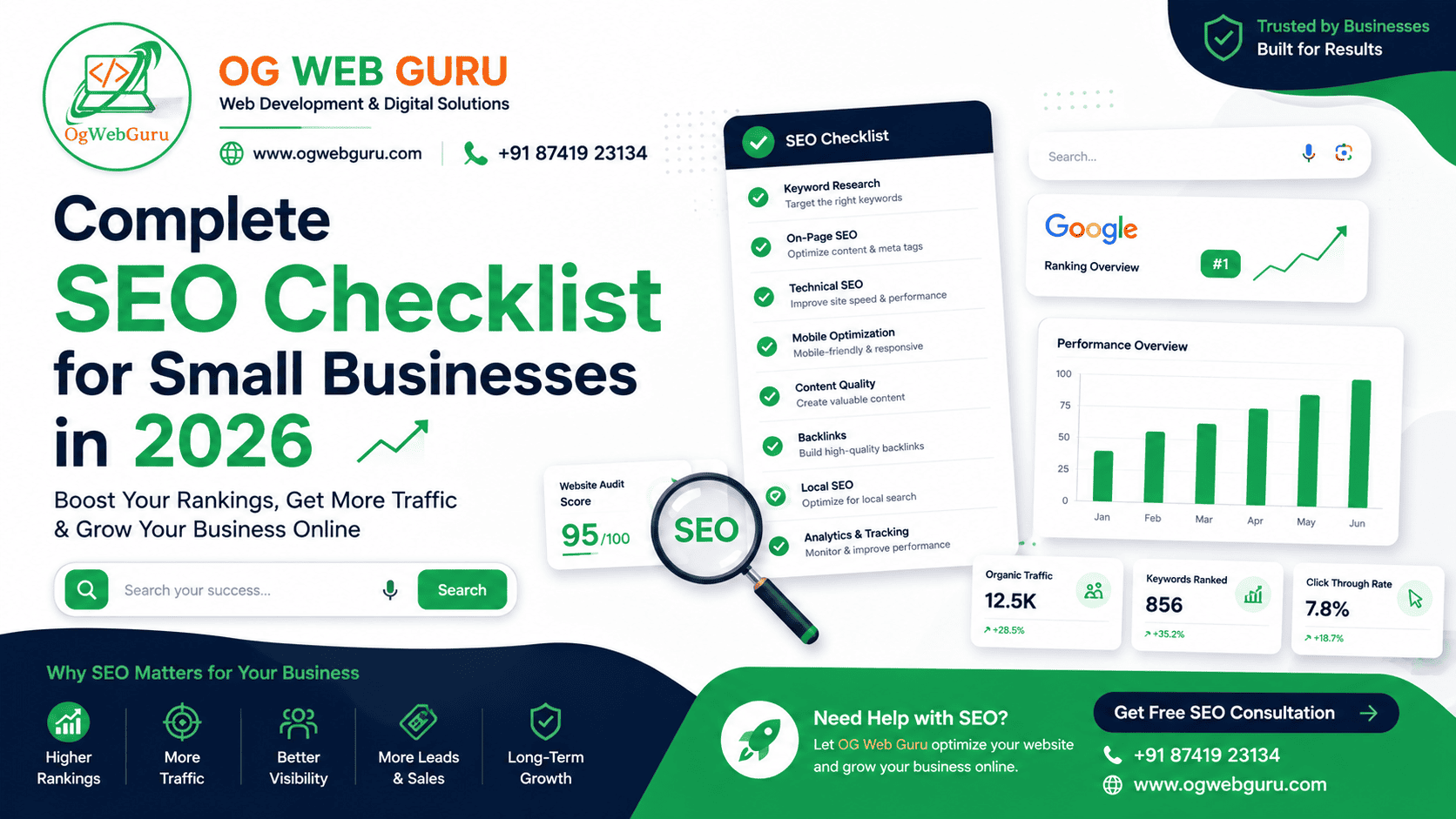
Most small business owners know they need SEO. Very few actually know what that means in practice — what to do first, what matters most, and what's just noise from people trying to sell them something.
This checklist cuts through all of that. Every item here has a direct impact on your Google rankings in 2026. Some take 10 minutes. Some take a few hours. All of them matter.
Work through this section by section — and by the time you're done, your website will be in better shape than 90% of your local competitors.
Why SEO Still Matters More Than Ever for Small Businesses
Paid ads stop the moment you stop paying. SEO compounds. A page that ranks today can drive traffic for years without spending another rupee.
Consider this: over 68% of all online experiences begin with a search engine. And the first five organic results capture more than 67% of all clicks. If you're not showing up, someone else is — and they're getting your customers.
For local businesses especially, ranking on Google is the single highest-ROI marketing activity you can invest in. Let's make sure you're doing it right.
of online experiences start with search
of clicks go to the top 5 results
per click once you rank organically
of Google searches have local intent
Section 1: Technical SEO Checklist
The foundation. If your site has technical problems, nothing else you do will work well.
Google marks non-HTTPS sites as "Not Secure." This kills trust and is a confirmed ranking signal. Every website in 2026 must run on HTTPS — your host should offer this free via Let's Encrypt.
A sitemap tells Google every page on your site. Without it, some pages may never get indexed. Go to search.google.com/search-console → Sitemaps → submit your sitemap.xml URL.
Check for 404 errors, redirect chains, and pages blocked by robots.txt. Crawl errors tell Google that your site is messy — and messy sites rank lower.
Google measures LCP (Largest Contentful Paint), INP (Interaction to Next Paint), and CLS (Cumulative Layout Shift). Run your site through PageSpeed Insights (pagespeed.web.dev). A score below 50 needs immediate attention.
Google uses mobile-first indexing — meaning it crawls and ranks your mobile version first. If your site looks broken on a phone, your rankings suffer even for desktop searches.
Compress images, use a CDN, enable browser caching, and minify CSS/JS files. Every extra second of load time reduces conversions and hurts your rank. This is where many small business sites fail silently.
URLs should be readable and descriptive. yoursite.com/seo-services-udaipur is good. yoursite.com/page?id=7&cat=3 is not. Clean URLs rank better and get more clicks.
Schema tells Google exactly what your content is — a product, a review, a local business, an FAQ. It unlocks rich results (star ratings, FAQs, prices) in search listings, which dramatically increases click-through rates.
Section 2: On-Page SEO Checklist
What's actually on your pages — the content, structure, and signals Google reads to understand what you're about.
Your title tag is the blue link in Google results. It must include your primary keyword and be compelling enough to earn the click. Don't duplicate it across pages — Google will pick one and ignore the rest.
Meta descriptions don't directly affect rankings but they control your click-through rate. Write them like ad copy — what will someone get when they click? Make it specific and useful.
The H1 is your page headline — there should only be one. It should contain your target keyword naturally, not stuffed. Google uses the H1 as a major signal to understand what the page is about.
Subheadings help Google understand the structure of your content and help readers skim. Use H2s for main sections, H3s for subsections. Include secondary keywords naturally in subheadings.
Google reads your content top to bottom. Mentioning your primary keyword early signals clearly what the page is about. Don't wait until paragraph five to say what you offer.
Search engines can't see images — they read alt text. Write a short, descriptive phrase for every image: "handmade silver earrings Jaipur" beats "image001.jpg" every time. Also helps with Google Image Search traffic.
Link from your blog posts to your service pages, from your homepage to your most important content. Internal links spread authority across your site and help Google understand which pages matter most.
Someone searching "best CA near me" wants a recommendation, not a history of accounting. Match your content to what the searcher actually wants — Google measures this through engagement signals like bounce rate and dwell time.
Section 3: Local SEO Checklist
If you serve a local area — city, state, or region — local SEO is where most of your wins will come from.
This is non-negotiable for local businesses. Fill in every field — business name, address, phone, hours, website, category, photos, and services. Businesses with complete profiles get 7x more clicks than incomplete ones.
NAP = Name, Address, Phone. These must be identical on your website, Google Business Profile, Justdial, Sulekha, IndiaMART, and every other directory. Even small differences (Road vs Rd) confuse Google's local algorithm.
Reviews are a major local ranking factor and the #1 thing potential customers check before calling. Ask every satisfied customer for a review. Respond to all reviews — positive and negative. Activity signals trust to Google.
If you serve multiple cities or areas, create a dedicated page for each. "Web Development Services in Udaipur" and "Web Development Services in Jaipur" as separate pages — each targeting local search terms in that city.
Embedding your Google Maps location on your website reinforces your local signals and makes it easy for customers to find you. It's a small thing that consistently helps local rankings.
Justdial, Sulekha, IndiaMART (for B2B), TradeIndia, and industry-specific directories build local citation authority. These are free to list on and directly reinforce your NAP consistency signals.
Google Business posts (offers, updates, events) keep your profile active and signal to Google that your business is current. Post at least twice a month. Even a short product update counts.
Section 4: Content SEO Checklist
Content is how you rank for the questions your customers are asking. Done right, it's your most durable traffic source.
Use Google's free "People Also Ask" and autocomplete, plus tools like Ubersuggest or Google Keyword Planner. Map 1–2 primary keywords to each page. Don't guess — find what people actually search.
A single "Services" page trying to rank for web design, SEO, and app development will rank for none of them. Each service needs its own page with dedicated content, keywords, and examples.
Every question your customers ask is a potential blog post that ranks on Google. "How much does a website cost?" "What's the difference between SEO and paid ads?" These searches happen millions of times a day.
Thin content (under 300 words) rarely ranks for competitive terms. Your main service pages should be comprehensive — cover what you offer, who it's for, how it works, pricing signals, and FAQs.
FAQ sections with Schema markup win "People Also Ask" boxes in Google results — which show up above the regular listings. Each FAQ is essentially a mini answer that Google can surface directly.
Google rewards freshness. Revisit your top pages every 6–12 months — update statistics, add new information, improve clarity. A 2023 article refreshed in 2026 often jumps back up the rankings.
Section 5: Link Building Checklist
Backlinks — other websites linking to yours — are still one of Google's strongest ranking signals. You don't need hundreds. You need the right ones.
A web design agency listed on "Top Web Designers in Rajasthan" gets a relevant, authoritative backlink. Find lists, directories, and roundups in your niche and get included.
Contributing an article to a reputable site in your industry earns you a backlink and a new audience. Aim for sites with real traffic — Domain Authority alone doesn't guarantee quality.
Businesses you work with, tools you use, associations you belong to — all of these are potential backlinks. A "Certified Partner" badge with a link from a vendor's website is a legitimate high-quality backlink.
Original research, comprehensive guides, free tools, industry statistics — these earn backlinks naturally because other sites reference them. The best link building strategy is creating something genuinely useful.
Your SEO Priority Order: Where to Start
If you're overwhelmed, here's the order that gives you the fastest results:
SEO Mistakes That Small Businesses Keep Making
"Web design" has millions of competing pages. "Web design agency in Udaipur" has a few hundred. Rank for the specific term first, then expand. Local and long-tail keywords convert better anyway.
SEO is a 3–6 month process for most keywords. Anyone promising page-one rankings in 30 days is either lying or targeting keywords nobody searches for. Consistent effort compounds into lasting results.
Writing "best web design Udaipur web design services Udaipur" fifteen times per page doesn't work — Google's algorithm has penalized this for years. Write for humans first. Mention keywords naturally.
A site that's hard to use on mobile loses rankings and customers. Google's mobile-first index means your mobile experience is your ranking experience. Test your site on your own phone regularly.
All the SEO optimization in the world won't save a site that takes 8 seconds to load. Speed is foundational. If your host is slow or your site is bloated with plugins, no content strategy will fix that.
Frequently Asked Questions
Conclusion: SEO Is a System, Not a One-Time Task
The businesses that win on Google aren't the ones who did SEO once and forgot about it. They're the ones who built a solid foundation, published useful content consistently, and kept their technical house in order.
This SEO checklist for small businesses gives you everything you need to get started — and to keep improving. Work through it section by section, check items off, and revisit it every quarter.
If you'd rather have a professional team handle the technical setup, on-page optimization, and speed improvements from the start, OG Web Guru builds fully SEO-optimized websites from ₹25,000 — so you start with the right foundation instead of fixing problems later.
Call or WhatsApp: +91 87419 23134 | ogwebguru.com